Tulsequah Chief Mine

Update on Collaborative Remediation Efforts

Overview

The Tulsequah Chief Mine is a historical underground mine site located in a remote part of northwestern British Columbia that was operated from 1951 to 1957 by a predecessor company to Teck. While no longer the owner, Teck is collaborating with the Province of British Columbia and the Taku River Tlingit First Nation to advance remediation. Since 2024, significant progress has been made, including enabling safe site access, partial stabilization of historical underground mine workings, water quality and aquatic ecosystem monitoring, and cleanup of site waste.

Progress to date

Teck and the Taku River Tlingit First Nation have undertaken two field seasons making important progress in the following areas:

Advancing Remediation in Partnership With the Taku River Tlingit First Nation

Teck and the Taku River Tlingit First Nation are working side by side to guide remediation planning. This includes shared governance through a Steering Committee and Technical Working Group that meet regularly to coordinate fieldwork, technical studies, and community engagement. This collaborative approach ensures Indigenous knowledge and community priorities inform remediation planning.


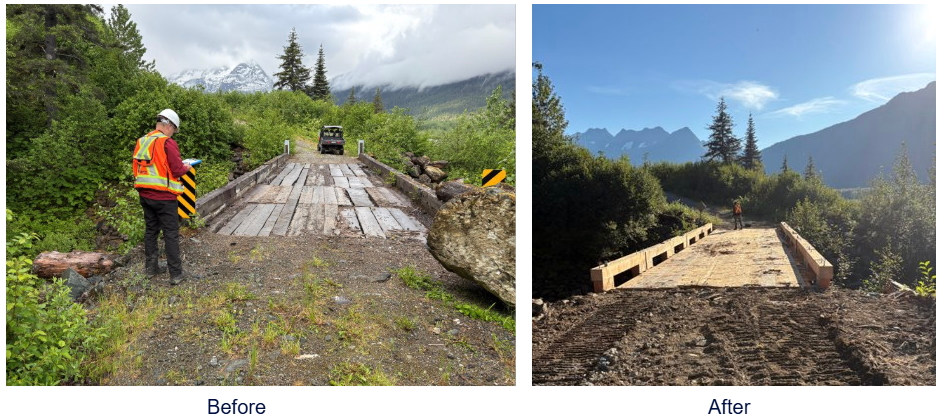
Improving Safe Access

Making the site safe and accessible has been a foundational step. Work completed includes repairing critical infrastructure, restoring safe use of the airstrip, constructing helipads, and establishing temporary accommodations after the historical camp was determined to be unusable. This has enabled technical teams and Taku River Tlingit First Nation representatives to work on site safely and consistently.

Stabilizing Underground Mine Workings

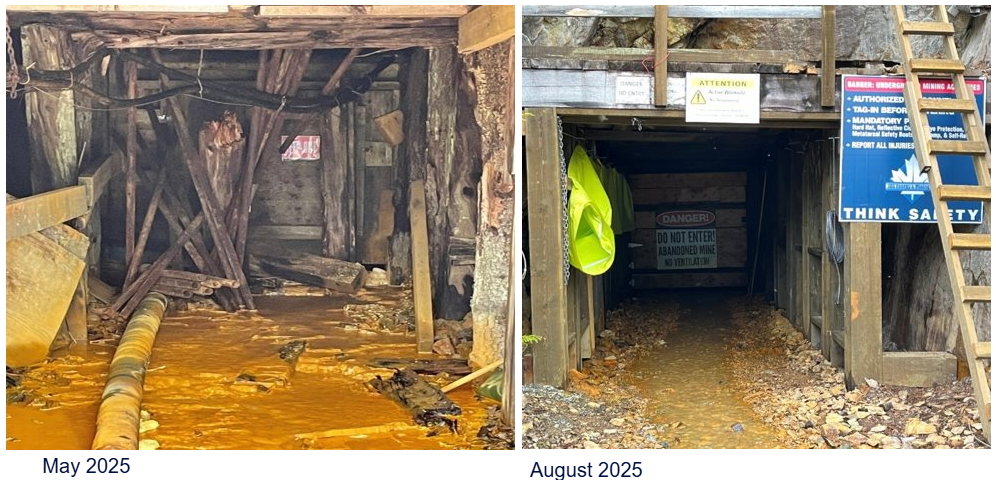
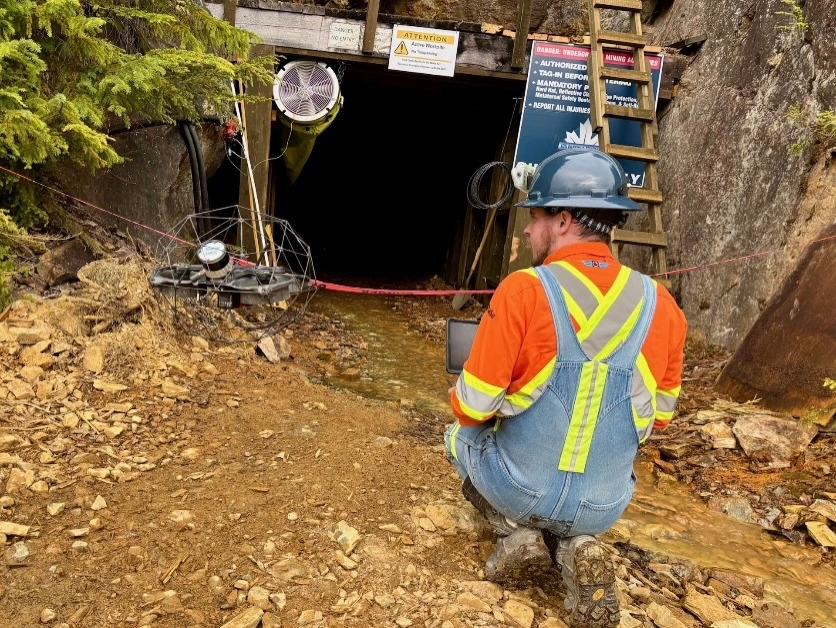
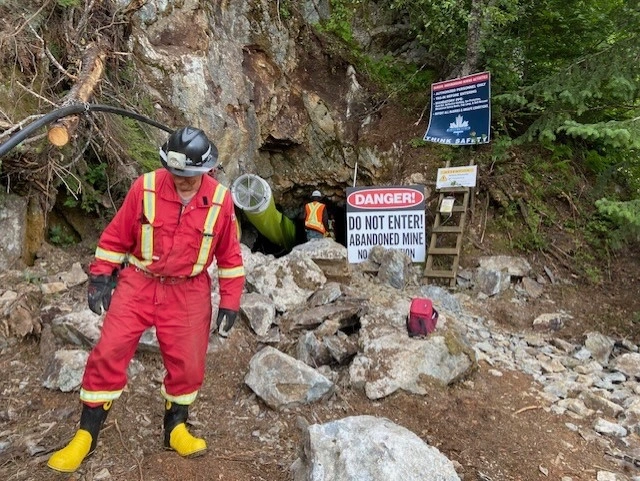
Understanding geotechnical conditions within the historical mine is essential to enable safe entry for the technical teams, in order to develop a long-term solution for the acid mine drainage. Teck used drones in 2024 and 2025 to safely survey underground levels and identify areas where stabilization was required. Ground control has been performed to stabilize portions of the upper four levels – this work will continue on all remaining levels in 2026.

Studying Water and Environmental Conditions


Water and aquatic monitoring has been carried out across multiple seasons, including sampling of water, sediment, benthic invertebrates, and fish. This monitoring will help define the extent of environmental impacts and track conditions over time. 

Cleaning Up Legacy Waste and Assessing Infrastructure

To support safe operations and reduce environmental risk, Teck removed hundreds of legacy waste items, including fuel drums and old batteries. 
The historical water treatment plant was assessed following mould remediation and cleanout of stored hazardous materials. It was found to not be functional without significant effort due to the deteriorated condition and past technical challenges. 

Developing a Long-Term Remediation Plan

Engineering work required to design underground plugs and address the source of acid mine drainage is progressing. This is a complex, multiyear process due to the remote location, short field season, aging infrastructure, underground conditions, and the need to ensure the selected solutions are safe, durable, and effective for decades to come. Planning is expected to continue into 2028, guided by input from Taku River Tlingit First Nation and provincial regulators.

Current Focus Areas

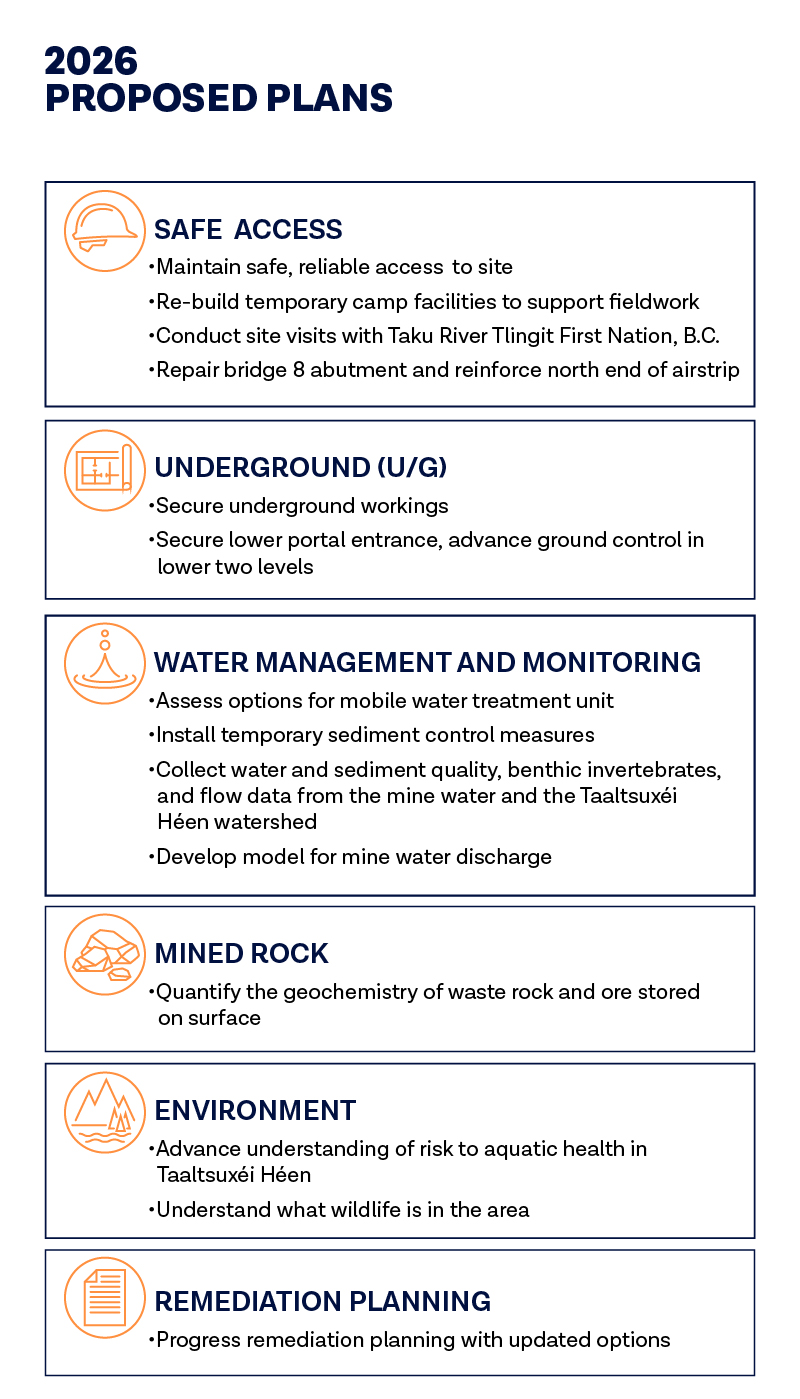
Through 2026, Teck will undertake a series of measures, including identifying possible locations for plugs to prevent future discharge, assessing the volume and geochemistry of waste rock and ore stored on the surface, continuing water quality and aquatic monitoring in Taaltsux̱éi Héen and progressing remediation planning.

Historical Timeline

Frequently Asked Questions

Teck Metals Ltd. is the corporate successor to a company that held an interest in the mine in the 1950s. Although Teck does not own or operate the site today, we are voluntarily supporting remediation planning as part of our commitment to responsible resource management and to our partnership with the Taku River Tlingit First Nation.

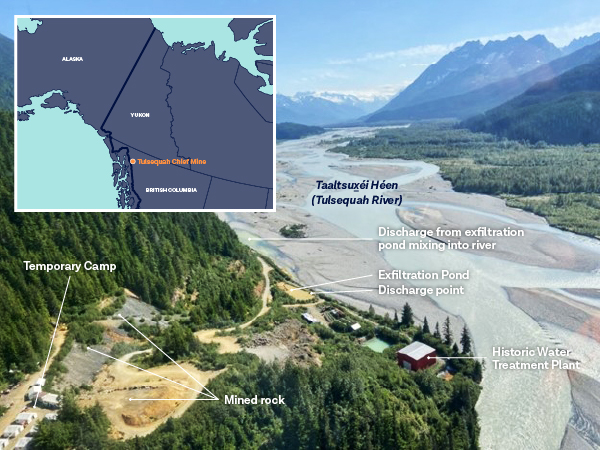
The historic mine produces acidic water that interacts with minerals underground, resulting in elevated metals in water and sediment immediately downstream of the discharge point. These effects are limited to ~3 km downstream of the discharge location in the Taaltsux̱éi Héen. 

Teck and Taku River Tlingit First Nation are conducting the fieldwork, engineering assessments, and environmental studies needed to design a longterm solution. This includes stabilizing underground workings to allow safe access for engineers, undertaking detailed aquatic effects monitoring, and assessing options. The final plan will be developed with Taku River Tlingit First Nation and validated through technical and regulatory review.

Remediation work to reduce acid mine drainage and improve water quality is expected to improve habitat conditions for insects and juvenile fish in the immediate area. 

Since 2024, Teck and Taku River Tlingit First Nation have improved access, strengthened underground portals, completed multiple seasons of drone surveys, expanded environmental monitoring, cleaned up legacy waste, and advanced engineering studies for long-term solutions.

A draft remediation plan is being targeted for 2026, with a final plan expected by 2028, subject to endorsement by the Taku River Tlingit First Nation. Concurrently, Teck is taking measures to help prevent waste from entering the watershed, removing historic hazardous and preparing the site for full remediation once a plan is finalized.

The site’s remote location, aviation‑only access, and deteriorated underground workings require a multi‑season, safety‑first approach to remediation

BC Government is leading consultation with Alaskan Tribes as part of its regulatory and transboundary responsibilities.

Teck Metals Ltd. is the corporate successor to a company that held an interest in the mine in the 1950s. Although Teck does not own or operate the site today, we are voluntarily supporting remediation planning as part of our commitment to responsible resource management and to our partnership with the Taku River Tlingit First Nation.

The historic mine produces acidic water that interacts with minerals underground, resulting in elevated metals in water and sediment immediately downstream of the discharge point. These effects are limited to ~3 km downstream of the discharge location in the Taaltsux̱éi Héen. 

Teck and Taku River Tlingit First Nation are conducting the fieldwork, engineering assessments, and environmental studies needed to design a longterm solution. This includes stabilizing underground workings to allow safe access for engineers, undertaking detailed aquatic effects monitoring, and assessing options. The final plan will be developed with Taku River Tlingit First Nation and validated through technical and regulatory review.

Remediation work to reduce acid mine drainage and improve water quality is expected to improve habitat conditions for insects and juvenile fish in the immediate area. 

Since 2024, Teck and Taku River Tlingit First Nation have improved access, strengthened underground portals, completed multiple seasons of drone surveys, expanded environmental monitoring, cleaned up legacy waste, and advanced engineering studies for long-term solutions.

A draft remediation plan is being targeted for 2026, with a final plan expected by 2028, subject to endorsement by the Taku River Tlingit First Nation. Concurrently, Teck is taking measures to help prevent waste from entering the watershed, removing historic hazardous and preparing the site for full remediation once a plan is finalized.

The site’s remote location, aviation‑only access, and deteriorated underground workings require a multi‑season, safety‑first approach to remediation

BC Government is leading consultation with Alaskan Tribes as part of its regulatory and transboundary responsibilities.

Photo Gallery

Taaltsux̱éi Héen water sampling.


Drone survey 2025 at 5400 Level mine entrance.


Engineering inspection 2025 at 6400 Level mine entrance.


Camp for 2025 field season work.


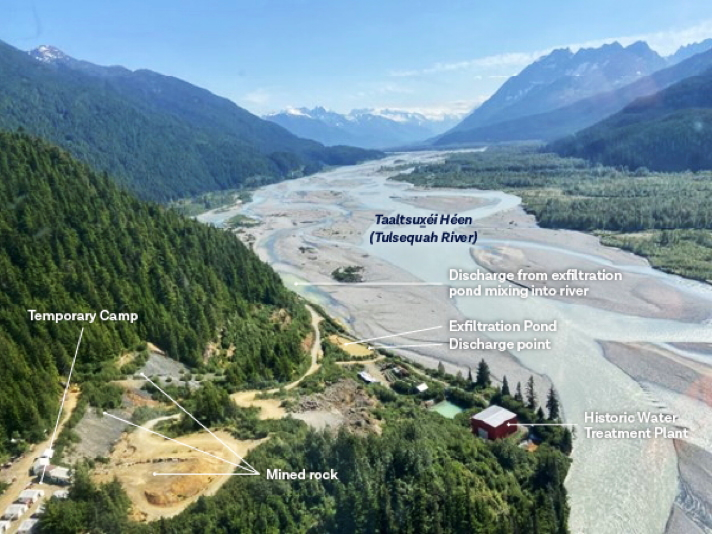
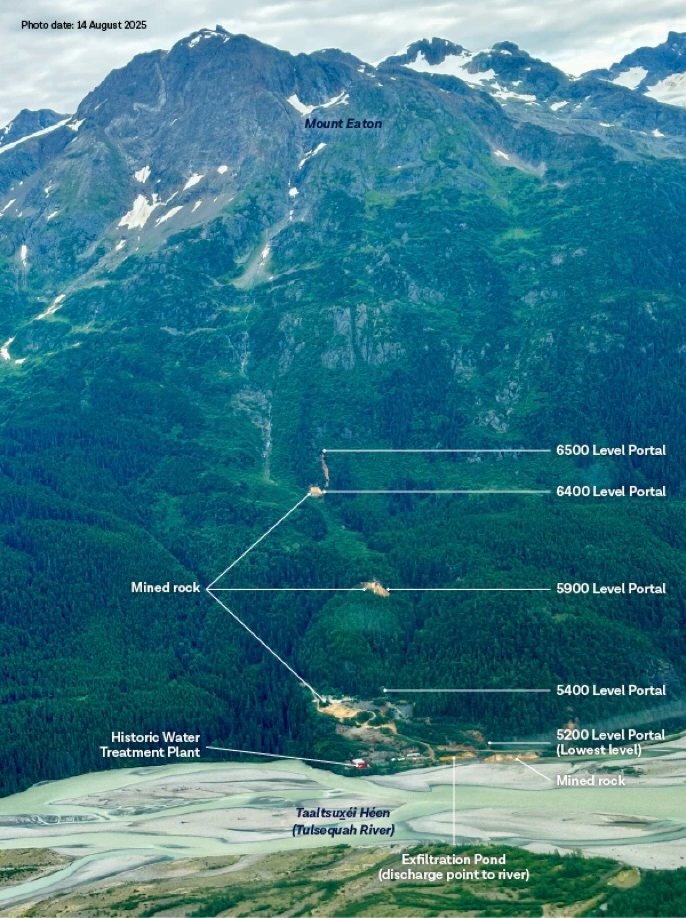
Annotated overview.


Annotated overview.


Annotated overview.